Debt
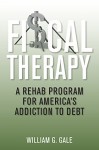
In just a few short years, federal budget deficits and the national debt rose from obscurity to become America’s newest obsession. Unfortunately, while interest in the issue has grown, rigid ideology and an increasingly vitriolic and entrenched public dialogue have crowded out thoughtful discourse, preventing even basic education on budgets, the deficit, and the role of government.
Fiscal Therapy is an antidote to the demagoguery and half-truths. It explains the scope and nature of the deficit problem facing the United States and offers sensible, balanced, workable solutions in clear language, drawing on national history, the experiences of other countries, and economic analysis. According to William G. Gale, senior fellow at the Brookings Institution and codirector of the Urban-Brookings Tax Policy Center, what is at stake in solving the deficit problem is the social contract that governs how Americans interact with their government.
Restructuring government and balancing the long-term budget are monumental tasks. While Americans need not and should not abandon their fundamental values, the required actions will be profound. No country makes such changes easily or quickly, but failure to act will ultimately guarantee long-term economic ruin.
Gale proposes a set of policies to restore fiscal balance through shared sacrifice. His proposal would restructure taxes and spending programs, cut overall government outlays, raise revenues, and put the economy and the budget on sound footing.
Contents 1. Introduction
2. How We Got Here
3. Where We’re Heading
4. Why the Deficit Is a Problem?
5. Fixing the Problem

“How you think is everything.” This simple and true statement exemplifies how the product of our labors is first built by our minds. Everyday, we make several financial decisions, yet many of us practice little to no daily mindfulness of our money until there are cash crunches or other problems that must be addressed. This book is the tool you need to breakthrough and achieve consistent daily awareness of your money and your mindset towards money. Containing 365 personal finance affirmations–one for each day of the year–this book provides daily meditations to help you break through mental and habitual roadblocks, negative predispositions, and self-sabotaging beliefs that stand in the way of financial success. Each affirmation has been carefully designed based on extensive research into the personal finance and self achievement fields. The simplicity and elegance of each affirmation provides a tool to help you conquer the financial challenges in your life while supporting your long-term goals.
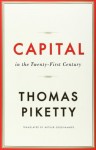
What are the grand dynamics that drive the accumulation and distribution of capital? Questions about the long-term evolution of inequality, the concentration of wealth, and the prospects for economic growth lie at the heart of political economy. But satisfactory answers have been hard to find for lack of adequate data and clear guiding theories. In Capital in the Twenty-First Century, Thomas Piketty analyzes a unique collection of data from twenty countries, ranging as far back as the eighteenth century, to uncover key economic and social patterns. His findings will transform debate and set the agenda for the next generation of thought about wealth and inequality.
Piketty shows that modern economic growth and the diffusion of knowledge have allowed us to avoid inequalities on the apocalyptic scale predicted by Karl Marx. But we have not modified the deep structures of capital and inequality as much as we thought in the optimistic decades following World War II. The main driver of inequality–the tendency of returns on capital to exceed the rate of economic growth–today threatens to generate extreme inequalities that stir discontent and undermine democratic values. But economic trends are not acts of God. Political action has curbed dangerous inequalities in the past, Piketty says, and may do so again.
A work of extraordinary ambition, originality, and rigor, Capital in the Twenty-First Century reorients our understanding of economic history and confronts us with sobering lessons for today.
Product Features
- A work of extraordinary ambition, originality, and rigor, Capital in the Twenty-First Century reorients our understanding of economic history and confronts us with sobering lessons for today.
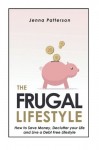
THE FRUGAL LIFESTYLE: How to Save Money, Declutter Your Life and Live a Debt Free Lifestyle Do you want to get out of debt once and for all? Are you tired of living from paycheck to paycheck, feeling like you never have quite enough? With this book, you have a comprehensive guide to doing a complete overhaul of your financial situation from debt relief to retirement planning and everything in between. You will even learn how to do a professional assessment of your finances so that you can see exactly what you have to work with and how to construct a plan uniquely suited to your needs. After reading this guide to frugal living, you won’t need to spend extra money that you don’t have on a professional financial advisor. Discover how to live frugally and free yourself from debt painlessly Also, you’ll discover.. Simple lifestyle changes that will eliminate clutter and save you money. Proven investment strategies that you can use to earn more money. How you can build a savings no matter how tight your budget is. And much more! Table of Contents Chapter 1: Do it Yourself Financial Assessment Learn how to do a financial assessment like a pro so you can see exactly where you stand as of now. Chapter 2: Freeing Yourself from Debt Read about strategies for managing your debt and becoming totally debt free Chapter 3: Planning Your Dream Retirement Get tips and tricks for planning for the retirement you always dreamed of. Chapter 4: A Brief Guide to Wall Street Learn the basics of investing and how to build an investment portfolio with low risk and high reward. Chapter 5: Savings 101 Everything you need to know about building a savings in any situation Chapter 6: Minimalism for Maximum Gain How to cut your expenses by eliminating clutter and knowing your priorities Chapter 7: Budgeting for Freedom All you need to know to create your own budget for getting out of debt, saving money, and achieving financial freedom

The second book in the New York Times Bestselling Dark Romance Series. “You say I’ll never own you. If I win—you willingly give me that right. You sign not only the debt agreement, but another—one that makes me your master until your last breath is taken. You do that, and I’ll give you this.” Nila Weaver’s family is indebted. Stolen, taken, and bound not by monsters but by an agreement written over six hundred years ago, she has no way out. She belongs to Jethro as much as she denies it. Jethro Hawk’s patience is running out. His inheritance gift tests, challenges, and surprises him—and not in good ways. He hasn’t leashed her but he thinks he might’ve found a way to bind her forever. Debts are mounting. Payment waiting. For release date alerts please sign up to: http://eepurl.com/120b5
Awareness of design smells – indicators of common design problems – helps developers or software engineers understand mistakes made while designing, what design principles were overlooked or misapplied, and what principles need to be applied properly to address those smells through refactoring. Developers and software engineers may “know” principles and patterns, but are not aware of the “smells” that exist in their design because of wrong or mis-application of principles or patterns. These smells tend to contribute heavily to technical debt – further time owed to fix projects thought to be complete – and need to be addressed via proper refactoring.
Refactoring for Software Design Smells presents 25 structural design smells, their role in identifying design issues, and potential refactoring solutions. Organized across common areas of software design, each smell is presented with diagrams and examples illustrating the poor design practices and the problems that result, creating a catalog of nuggets of readily usable information that developers or engineers can apply in their projects. The authors distill their research and experience as consultants and trainers, providing insights that have been used to improve refactoring and reduce the time and costs of managing software projects. Along the way they recount anecdotes from actual projects on which the relevant smell helped address a design issue.A comprehensive catalogue of structural design smells and their refactoring solutions to solve problems occurring in designExplains the importance of smells in managing technical debt, an area of increased concern at software engineering conferencesEach smell includes examples, source code, and visualization diagrams to facilitate understandingDescribes solutions across common software design concepts and smells that cross multiple domains
Ann Harris, an ace debt collector, thought she had it all figured out – money in the bank, a promising career at a law firm, and an unwavering view of what it meant to be a success. Her values are challenged when suddenly she is outperformed by the demons inside her and coerces Thomas Moore, a man at the end of his rope, to become a victim of her anger and conviction against people like her father who were the irresponsible deadbeats of the world. When her law firm forces her into a paid leave of absence, Ann is faced with life-threatening depression which begs her to find her soul again, and slowly, the coldness inside Ann melts when she begins to learn the truth about David, her dying father, and the effect of her damaging ideals upon those who loved her most – such as her younger sister Kate and her devoted ex-boyfriend Paul. Debt is a journey into the heart to explore pride, self-reliance, and our own values which give us the illusion of what it means to survive in a world where one man’s misfortune often becomes another man’s profit.

Berlin detective Jan Tommen expected to wake up with a hangover—not a murder charge. But a well-known judge has been brutally killed and hard evidence places Jan at the crime scene. When disturbing gaps in Jan’s memory make finding an alibi impossible, the case against him looks open and shut.
Faced with life on the inside, Jan flees police custody to take refuge with an old friend deeply enmeshed in the capital’s seedy underworld. Hampered by a citywide manhunt, Jan soon finds that investigating leads while eluding capture isn’t easy. Before long, he’s relying on a team of misfits for help, including an icy blonde medical examiner and a brilliant but reclusive computer whiz.
When a lucky break leads Jan to connect the murders to a heinous trafficking ring, the team risks it all to find answers. Meanwhile, the body count continues to rise and the police department starts to close in. Desperate to prove his innocence, Jan must identify the true killer—before his time finally runs out.
Experts, pundits, and politicians agree: public debt is hindering growth and increasing unemployment. Governments must reduce debt at all cost if they want to restore confidence and get back on a path to prosperity. Maurizio Lazzarato’s diagnosis, however, is completely different: under capitalism, debt is not primarily a question of budget and economic concerns but a political relation of subjection and enslavement. Debt has become infinite and unpayable. It disciplines populations, calls for structural reforms, justifies authoritarian crackdowns, and even legitimizes the suspension of democracy in favor of “technocratic governments” beholden to the interests of capital. The 2008 economic crisis only accelerated the establishment of a “new State capitalism,” which has carried out a massive confiscation of societies’ wealth through taxes. And who benefits? Finance capital. In a calamitous return to the situation before the two world wars, the entire process of accumulation is now governed by finance, which has absorbed sectors it once ignored, like higher education, and today is often identified with life itself. Faced with the current catastrophe and the disaster to come, Lazzarato contends, we must overcome capitalist valorization and reappropriate our existence, knowledge, and technology.
In Governing by Debt, Lazzarato confronts a wide range of thinkers — from Félix Guattari and Michel Foucault to David Graeber and Carl Schmitt — and draws on examples from the United States and Europe to argue that it is time that we unite in a collective refusal of this most dire status quo.