Debt
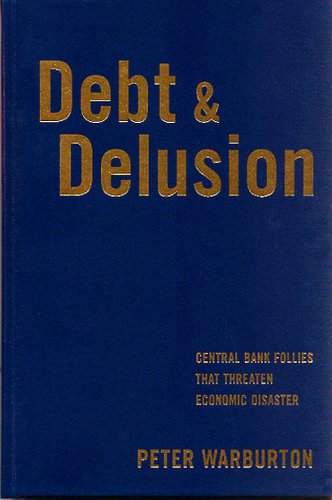
It’s been almost seven years since I wrote Debt and Delusion. So naturally, readers have a right to ask, “Why produce an updated version at this time?” There are at least three reasons, the cheapest of which is that the author is surprised and flattered to find that it is in demand and there has long ceased to be any supply.
More than that, like an abandoned mine, the book stands as a monument to what was already known about the global credit expansion and the strains in the financial system before the halving of equity market prices from the early 2000 peaks. Most importantly, and sad to say, this equity market trauma foreshadows even more disastrous results of the financial folly that has reached proportions unimaginable in the summer of 1998. And so, the primary function of the book — “as a timely warning of the perils that lie ahead” — remains valid.
Debt and Delusion exposes serious flaws in the development of the global financial system starting in the early 1990s, singling out the world’s largest central banks for special criticism. Their negligent oversight has permitted an explosion of corporate and household credit that has fueled a succession of false markets in stocks, bonds, and property. Alarmed by the monster so created, the U.S. Federal Reserve has spent much of the past five years staving off the evil day when foolish lending turns into bad debt.
Far from being the architects of economic stability and low inflation, the world’s central bankers have ushered in a new era of financial fragility and latent instability. Innovations in the use of derivatives, structured products, and other complex financial instruments have been applauded by the central banks on narrow technical criteria. But these supposed bastions of conservatism have failed to comprehend the wider implications for financial stability.
From poorly documented home loans to sub-prime auto loans to subordinated corporate debt and junk bonds, permanently easy access to credit has compromised economic management in the U.S., U.K., and other English-speaking nations and has fostered an illusion of prosperity and well being.
Lamentably, this staggering collective flight from reason has been endorsed by the economics establishment.
The failure of many of the finest economic minds to engage with the rapid evolution of our financial structures and institutions has led to a superficial assessment of this unprecedented credit experiment. Only now, as various credit markets face the inevitable tests of higher interest rates and the realistic pricing of credit risks, is the threat of a pandemic of debt-related distress beginning to be taken seriously. Government budgets, already strained by the weight of social support, have limited scope to respond.
In short, tougher economic times lie ahead, when personal debts will hang more onerously than for 75 years. Debt and Delusion recommends a hasty! reappraisal of the debt requirements of corporations and households alike.
Peter Warburton
September 2005
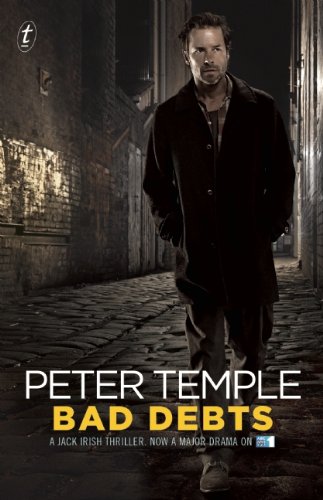
Meet Jack Irish, criminal lawyer, debt collector, football lover, turf watcher, trainee cabinetmaker, and one of the best crime characters ever created.
When Jack receives a puzzling message from a jailed ex-client he’s too deep in misery over his football team’s latest loss to take much notice. Next thing Jack knows, the ex-client’s dead and he’s been drawn into a life-threatening investigation involving high-level corruption, dark sexual secrets, shonky property deals, and murder. With hitmen after him, shady ex-policemen at every turn, and the body count rising, Jack needs to find out what’s going on—and fast.
The first novel in the iconic Jack Irish series, Bad Debts was first published in 1996 and won the Australia’s crime writing prize, the Ned Kelly Award, for Best First Novel. Peter Temple went on to win Australia’s highest literary honor, the Miles Franklin Award, in 2010 for Truth as well many other awards and accolades both in Australia and internationally.
Product Features
- Used Book in Good Condition
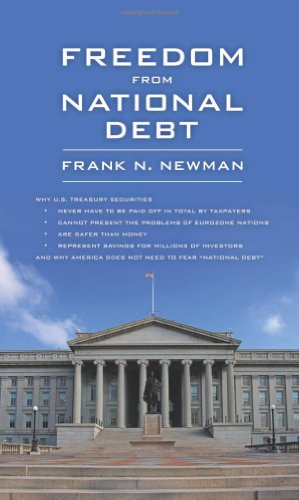
America is unjustly worried about ”national debt,” believing it can no longer do the many things that mark it as a great nation. Discussions of national undertakings–including infrastructure repair, jobs programs, military modernization, and disease prevention–have all been stifled through fear of insolvency. America has convinced itself that it can no longer afford, as a nation, to do many of the productive things that it has done so well over its history.
That’s a great shame, because America remains a nation of tremendous resources in every sense, and the underlying assumptions about U.S. government financial instruments are not correct. America can never face the debt problems of nations like Greece, thanks to its fundamentally different financial system.
This short book explains why such fears should not hold back America, and why even the expression ”national debt” is neither meaningful nor appropriate for the United States.
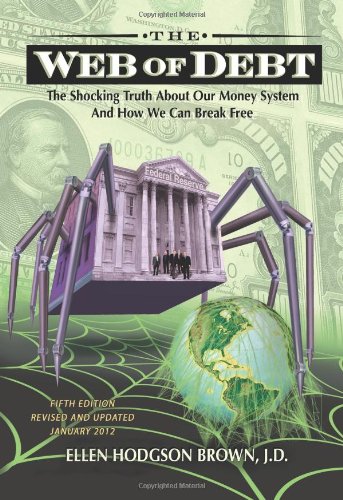
EXPLODING THE MYTHS ABOUT MONEY. Our money system is not what we have been led to believe. The creation of money has been privatized, or taken over by a private money cartel. Except for coins, all of our money is now created as loans advanced by private banking institutions — including the Federal Reserve, the branches of which are 100% privately owned. Banks create the principal but not the interest to service their loans. To find the interest, new loans must continually be taken out, expanding the money supply, inflating prices — and robbing you of the value of your money. Web of Debt unravels the deception and presents a crystal clear picture of the financial abyss towards which we are heading. Then it explores a workable alternative, one that was tested in colonial America and is grounded in the best of American economic thought, including the writings of Benjamin Franklin, Thomas Jefferson and Abraham Lincoln. If you care about financial security, your own or the nation’s, you should read this book.
Product Features
- Used Book in Good Condition
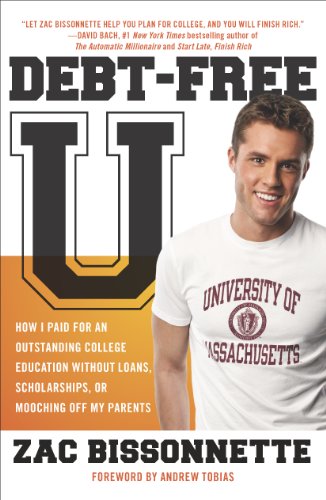
This book can save you more than $100,000.
These days, most people assume you need to pay a boatload of money for a quality college education. As a result, students and their parents are willing to go into years of debt and potentially sabotage their entire financial futures just to get a fancy name on their diploma.
But Zac Bissonnette is walking proof that this assumption is not only false, but dangerous-a class con game designed to rip you off and doom your student to a post-graduation life of near poverty . From his unique double perspective-he’s a personal finance expert (at Daily Finance) AND a current senior at the University of Massachusetts-Zac figured out how to get an outstanding education at a public college, without bankrupting his parents or taking on massive loans.
Armed with his personal knowledge, the latest data, and smart analysis, Zac takes on the sacred cows of the higher education establishment. He reveals why a lot of the conventional wisdom about choosing and financing college is not only wrong but hazardous to you and your child’s financial future. You’ll discover, for instance, that:
* Student loans are NOT a necessary evil. Ordinary middle class families can- and must-find ways to avoid them, even without scholarships.
* College “rankings” are useless-designed to sell magazines and generate hype. If you trust one of the major guides when picking a college, you face a potential financial disaster.
* The elite graduate programs accept lots of people with non-elite bachelors degrees. So do America’s most selective employers. The name on a diploma ultimately won’t help your child have a more successful career or earn more money.
Zac can prove every one of those bold assertions – and more. No matter what your current financial situation, he has a simple message for parents: “RELAX! Your kid will be able to get a champagne education on a beer budget!”
This book can save you more than $100,000.
These days, most people assume you need to pay a boatload of money for a quality college education. As a result, students and their parents are willing to go into years of debt and potentially sabotage their entire financial futures just to get a fancy name on their diploma.
But Zac Bissonnette is walking proof that this assumption is not only false, but dangerous-a class con game designed to rip you off and doom your student to a post-graduation life of near poverty . From his unique double perspective-he’s a personal finance expert (at Daily Finance) AND a current senior at the University of Massachusetts-Zac figured out how to get an outstanding education at a public college, without bankrupting his parents or taking on massive loans.
Armed with his personal knowledge, the latest data, and smart analysis, Zac takes on the sacred cows of the higher education establishment. He reveals why a lot of the conventional wisdom about choosing and financing college is not only wrong but hazardous to you and your child’s financial future. You’ll discover, for instance, that:
* Student loans are NOT a necessary evil. Ordinary middle class families can- and must-find ways to avoid them, even without scholarships.
* College “rankings” are useless-designed to sell magazines and generate hype. If you trust one of the major guides when picking a college, you face a potential financial disaster.
* The elite graduate programs accept lots of people with non-elite bachelors degrees. So do America’s most selective employers. The name on a diploma ultimately won’t help your child have a more successful career or earn more money.
Zac can prove every one of those bold assertions – and more. No matter what your current financial situation, he has a simple message for parents: “RELAX! Your kid will be able to get a champagne education on a beer budget!”
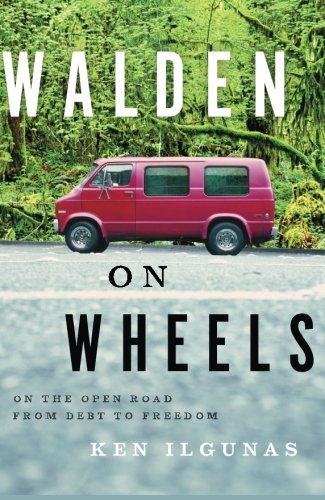
In this frank and witty memoir, Ken Ilgunas lays bare the existential terror of graduating from the University of Buffalo with $32,000 of student debt. Ilgunas set himself an ambitious mission: get out of debt as quickly as possible. Inspired by the frugality and philosophy of Henry David Thoreau, Ilgunas undertook a 3-year transcontinental jour¬ney, working in Alaska as a tour guide, garbage picker, and night cook to pay off his student loans before hitchhiking home to New York.
Debt-free, Ilgunas then enrolled in a master’s program at Duke University, determined not to borrow against his future again. He used the last of his savings to buy himself a used Econoline van and outfitted it as his new dorm. The van, stationed in a campus parking lot, would be more than an adventure—it would be his very own “Walden on Wheels.”
Freezing winters, near-discovery by campus police, and the constant challenge of living in a confined space would test Ilgunas’s limits and resolve in the two years that followed. What had begun as a simple mission would become an enlightening and life-changing social experiment. Walden on Wheels offers a spirited and pointed perspective on the dilemma faced by those who seek an education but who also want to, as Thoreau wrote, “live deep and suck out all the marrow of life.”
The stirring and striking poems in Lynn Xu’s debut collection touch on an array of themes, including thinking of love as an argument; Shakespeare; the American landscape transformed into text; the Occupy Movement; and the experiences wrought from travels in Mexico, Shanghai, and New York City. Named after the first part of Marcus Aurelius’s Meditations, this collection draws inspiration from history as the author looks to the dead for guidance amid the abstractions of contemporary life. Perceptive and filled with insight into what it means to be human, the poems in this collection will resonate with readers long after setting the book down.
Product Features
- Used Book in Good Condition
The coming financial apocalypse and what government and individuals can do to insulate themselves against the worst shocks
In this controversial book a noted adherent of Austrian School of Economics theories advances the thesis that the United States is fast approaching the end stage of the biggest asset bubble in history. He describes how the bursting of the bubble will cause a massive interest rate shock that will send the US consumer economy and the US government—pumped up by massive Treasury debt—into bankruptcy, an event that will send shockwaves throughout the global economy. Michael Pento examines how policies followed by both the Federal Reserve and private industry have contributed to the impending interest rate disaster and highlights the similarities between the US and European debt crisis. But the book isn’t all doom and gloom. Pento also provides well-reasoned solutions that, government, industry and individuals can take to insulate themselves against the coming crisis.Paints an alarmingly vivid picture of the massive interest rate shock which soon will send consumers and the government into bankruptcyBacked by a wealth of historical and economic data, Pento explains how the bubble was created and what the U.S. can do to mitigate the impending crisisProvides investors with sound strategies for protecting themselves and their assets against the coming financial apocalypseExplains why retirees, in particular, will be at risk as real estate prices decline, pensions weaken, and the bond bubble bursts
Third printing, October 2010
Reviews
Michael’s focus is definitely for anyone who is in debt and wants some no-nonsense simple systems to bail out of it.
— Janine Bolon, founder of SmartCents Inc and author of ‘Money…It’s Not Just for Rich People’ and ‘Ditching Debt’
This book doesn’t waste time making its points, and there are many very good points. Michael Mihalik is a good teacher, and Debt is Slavery is the kind of how-to manual that should be handed out like tracts at an airport.
— MightyBargainHunter.com
Debt is Slavery is a great personal finance book, one of the best I’ve read.
— GetRichSlowly.org
The book is lean and mean – it doesn’t mince many words at all. If direct and clear advice is what you’re looking for, you can’t do much better than Debt is Slavery.
— TheSimpleDollar.com
Debt is Slavery is packed full of content and it prompted me to action. This book made so much sense to me and I think it helped me realize my true priorities. Your book is making a huge positive difference in my life. Thank you.
— BloggingAwayDebt.com
Book Description
In his book, Debt is Slavery, Michael Mihalik describes the 10 steps he personally used to gain control of his finances and pay off a large amount of debt.
The key to Mihalik’s method is changing the way people think about money. Mihalik contends that people who do not change their perceptions about money will never succeed in improving how they handle their finances because all action is born from thought.
Mihalik’s first technique is described in the title – equating debt with slavery. While this idea may seem extreme to some, people who are burdened with debt will definitely understand how borrowing money puts them in financial servitude to the lender. Successfully equating debt with slavery stops people from accumulating more debt, which is the first step towards recovery (similar to stopping the leak in a sinking boat prior to bailing out the water).
Mihalik goes on to describe other powerful ideas such as equating money with time (to eliminate unnecessary spending), evaluating the hidden cost of possessions, and avoiding the insidious influence of ubiquitous marketing. As the reader progresses through the book, their perceptions about money will transform until by Chapter 9, they will truly believe they can ‘Save 50 Percent of Your Salary’. The book ends with an in-depth description of a simple way to plan your finances.
The author states in the introduction that because people are busy and do not want to be distracted by ‘fluff’, he has boiled the book down to the absolute basics. The result is a hard-hitting book that is 128 pages cover-to-cover. There is a gem on every page and even the busiest person can find time to read this powerful book.
So much has changed…and yet, so much is exactly the same. Debt-Free Living has sold more than 300,000 copies in the two decades since Larry Burkett first laid down the challenge to live debt-free lives. And now, on the heels of the debt-fueled debacle that was 2008-2009, we need this message now more than ever.
With people’s credit, mortgages, car payments, salaries, commissions, and bills fluctuating daily, Debt-Free Living has never looked more attractive. This bestselling book has been updated and revised to reflect today’s realities alongside timeless biblical truth. Learn about the origin of most financial troubles and break out of the debt cycle. Debt-Free Living is a necessary resource to battle the ever-present temptation and trappings of more and more debt that keep weighing you down.