[African] Videos
In the years following the Glorious Revolution, independent slave traders challenged the charter of the Royal African Company by asserting their natural rights as Britons to trade freely in enslaved Africans. In this comprehensive history of the rise and fall of the RAC, William A. Pettigrew grounds the transatlantic slave trade in politics, not economic forces, analyzing the ideological arguments of the RAC and its opponents in Parliament and in public debate. Ultimately, Pettigrew powerfully reasons that freedom became the rallying cry for those who wished to participate in the slave trade and therefore bolstered the expansion of the largest intercontinental forced migration in history.
Unlike previous histories of the RAC, Pettigrew’s study pursues the Company’s story beyond the trade’s complete deregulation in 1712 to its demise in 1752. Opening the trade led to its escalation, which provided a reliable supply of enslaved Africans to the mainland American colonies, thus playing a critical part in entrenching African slavery as the colonies’ preferred solution to the American problem of labor supply.
In Africa’s Odious Debts, Boyce and Ndikumana reveal the shocking fact that, contrary to the popular perception of Africa being a drain on the financial resources of the West, the continent is actually a net creditor to the rest of the world. The extent of capital flight from sub-Saharan Africa is remarkable: more than $700 billion in the past four decades. But Africa’s foreign assets remain private and hidden, while its foreign debts are public, owed by the people of Africa through their governments.
Léonce Ndikumana and James K. Boyce reveal the intimate links between foreign loans and capital flight. More than half of the money borrowed by African governments in recent decades departed in the same year, with a significant portion of it winding up in private accounts at the very banks that provided the loans in the first place. Meanwhile, debt-service payments continue to drain scarce resources from Africa, cutting into funds available for public health and other needs. Controversially, the authors argue that African governments should repudiate these “odious debts” from which their people derived no benefit, and that the international community should assist in this effort.
A vital book for anyone interested in Africa, its future, and its relationship with the West.
Product Features
- Used Book in Good Condition
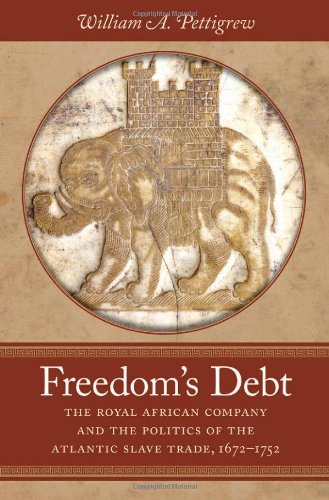
In the years following the Glorious Revolution, independent slave traders challenged the charter of the Royal African Company by asserting their natural rights as Britons to trade freely in enslaved Africans. In this comprehensive history of the rise and fall of the RAC, William A. Pettigrew grounds the transatlantic slave trade in politics, not economic forces, analyzing the ideological arguments of the RAC and its opponents in Parliament and in public debate. Ultimately, Pettigrew powerfully reasons that freedom became the rallying cry for those who wished to participate in the slave trade and therefore bolstered the expansion of the largest intercontinental forced migration in history.
Unlike previous histories of the RAC, Pettigrew’s study pursues the Company’s story beyond the trade’s complete deregulation in 1712 to its demise in 1752. Opening the trade led to its escalation, which provided a reliable supply of enslaved Africans to the mainland American colonies, thus playing a critical part in entrenching African slavery as the colonies’ preferred solution to the American problem of labor supply.