[Early] Videos

Debt Review Removal Misconceptions
Exiting debt review in South Africa can seem like a quick fix, but there’s a lot of misinformation out there. Here are some common misconceptions that could land you in hot water;
Myth #1: The Debt Review Removal Process is Easy.
Exiting debt review isn’t a simple process. It requires following specific legal procedures based on each client situation.
Myth #2: There are No Consequences.
Not complying with a debt review court order can lead to serious penalties under Section 160 of the National Credit Act (NCA).
161. Any person convicted of an offence in terms of this Act, is liable-
(a) in the case of a contravention of section 160( I), to a fine or to imprisonment
for a period not exceeding 10 years, or to both a fine and imprisonment; or
(b) in any other case, to a fine or to imprisonment for a period not exceeding 12
months, or to both a fine and imprisonment.
(Section 161 of the National Credit Act of 2005)
Myth #3: Thinking that you will still enjoy the protection and benefits of debt counselling.
Leaving debt review means losing legal safeguards and reverting to original credit terms. Be sure you’re financially ready before taking the leap because some creditors will take legal action.
Myth #4: Lawyers Do It All (My Attorney will deal with this)
Attorneys cannot directly remove your debt review listing. Debt counsellors handle the process with attorney assistance when needed for court appearances.
Myth #5: I Can Easily Afford Debt Review Removal
While exiting debt review offers freedom, it’s important to understand the financial implications. Contrary to popular belief, debt review removal often incurs hefty fees. Legal professionals like attorneys and some debt counsellors can charge anywhere between R1500 and R12000 for the application process itself.
Here at The National Debt Review Center, we offer a transparent approach with a fixed fee of R8550, payable conveniently over 2-3 months. However, this doesn’t cover everything. You’ll still need to factor in:
Your original Debt Repayments: Exiting debt review means resuming your original debt repayments, so ensure your financial situation can handle that responsibility.
Outstanding Debt Counselling Fees: There might be outstanding debt counselling fees from your previous debt review plan.
Therefore, we strongly advise that if you are considering debt review removal, do so only if your financial situation has truly improved and you’re no longer over-indebted.
Read the full article here https://ndrc.org.za/thinking-of-exiting-debt-review-or-debt-review-removal/
#southafrica #moneymanagement #financialfreedom #personalfinance #ndrc #debtcounselling #creditrepair #debtrelief #financialtips #debtfree

Are You considering paying Off Your Student Loan in The UK? In This video, We Delve in to The Pros and Cons of Early Student Loan Repayment and provide you with essential insights to help you make the Right decision.

SUPPORT THESE VIDEOS:
? Patreon – https://www.patreon.com/NextLevelLife
START INVESTING FOR FREE:
? M1 Finance – https://m1finance.8bxp97.net/NextLevelLife
GET YOUR FREE AUDIOBOOKS:
? Audible FREE Trial (Includes FREE Audiobook) – https://amzn.to/2zEFqhT
? My Favorite Books – https://thefinancialghost.com/books/
START YOUR OWN SIDE HUSTLE:
? Bluehost (Start Your Own Website) – https://www.bluehost.com/track/nextlevellife/
? ConvertKit (Build Your Business) – https://convertkit.com?lmref=cdSVnQ
? TubeBuddy (Grow Your Own YouTube Channel) – https://www.tubebuddy.com/NextLevelLife
? VidIQ (Alternative to TubeBuddy) – https://vidiq.com/#_l_1ra
You’re Wrong… Paying Debt Off Early Works (4 Reasons):
Conventional wisdom suggests that paying off debt early at the expense of some of your investment money in the short term is a bad trade unless the debt you’re carrying is high interest debt like credit cards. The thinking is why would anyone want to pay off debts with 5% or 6% interest rates when they could instead invest that extra payment money into the markets and earn 7%-10%. And, to be fair, there are certainly instances where that logic makes a lot of sense. I know the title of the video is pretty black and white, but that’s mainly because in my experience the discussion surrounding this topic presents it as a very clear cut decision and I feel that there’s a bit more nuance to it that often gets lost in translation. Today I’m going to be going over 4 reasons why I feel that, in certain situations, paying off even lower interest debts can be the better approach, even if it means giving up some investment returns in the short-term.
SUBSCRIBE FOR WEEKLY FINANCE VIDEOS: https://www.youtube.com/channel/UCbsDR27rGCFdDKQVRl_tgEQ?sub_confirmation=1
WANT TO LEARN MORE ABOUT MONEY?
All of my Personal Finance videos: https://goo.gl/3qMbXW
All of my Financial Independence & (Early) Retirement Videos: https://goo.gl/R5JU8E
All of my Stock Market & Investing Videos: https://goo.gl/swSUQN
All of my Debt-Related Videos: https://goo.gl/9HkrtF
All of my Budgeting Videos: https://goo.gl/D3iiSn
All of my Side Hustles/How to Make More Money Videos: https://goo.gl/oQui48
All of my Book Summaries: goo.gl/xmWeaD
SUPPORT THIS CHANNEL:
? Patreon (Exclusive Content From Me) – https://www.patreon.com/NextLevelLife
? M1 Finance (Start Investing Today) – https://m1finance.8bxp97.net/NextLevelLife
? You Need A Budget (Excellent Budgeting Software) – https://www.youneedabudget.com/
BOOKS & EDUCATIONAL RESOURCES:
? Audible FREE Trial (Includes FREE Audiobook) – https://amzn.to/2zEFqhT
? My Favorite Books – https://thefinancialghost.com/books/
? Skillshare (Affordable Online Video Classes) – skillshare.eqcm.net/NextLevelLife
START YOUR OWN SIDE HUSTLE:
? Bluehost (Start Your Own Website) – https://www.bluehost.com/track/nextlevellife/
? Wix (Alternative to Bluehost) – https://wixstats.com/?a=30171&c=2611&s1=
? ConvertKit (Build Your Business) – https://convertkit.com?lmref=cdSVnQ
? TubeBuddy (Grow Your Own YouTube Channel) – https://www.tubebuddy.com/NextLevelLife
? VidIQ (Alternative to TubeBuddy) – https://vidiq.com/#_l_1ra
???? NordVPN (Protect Yourself & Your Business Online) – https://go.nordvpn.net/aff_c?offer_id=15&aff_id=30988&url_id=902
???? Fiverr (Hire Freelancers to Help Scale Your Business) – https://track.fiverr.com/visit/?bta=51908&brand=fiverrcpa
? Grammarly (Free online Grammar Checker) – https://grammarly.go2cloud.org/aff_c?offer_id=182&aff_id=45298
OTHER RECOMMENDATIONS:
? Check Out My Merchandise (Shirts) – https://teespring.com/stores/next-level-life?aid=marketplace&tsmac=marketplace&tsmic=campaign
#PersonalFinance #Wealth #Money
Disclaimers: All opinions are my own, sponsors are acknowledged. Links in the description are typically affiliate links that let you help support the channel at no extra cost to you.
In the years following the Glorious Revolution, independent slave traders challenged the charter of the Royal African Company by asserting their natural rights as Britons to trade freely in enslaved Africans. In this comprehensive history of the rise and fall of the RAC, William A. Pettigrew grounds the transatlantic slave trade in politics, not economic forces, analyzing the ideological arguments of the RAC and its opponents in Parliament and in public debate. Ultimately, Pettigrew powerfully reasons that freedom became the rallying cry for those who wished to participate in the slave trade and therefore bolstered the expansion of the largest intercontinental forced migration in history.
Unlike previous histories of the RAC, Pettigrew’s study pursues the Company’s story beyond the trade’s complete deregulation in 1712 to its demise in 1752. Opening the trade led to its escalation, which provided a reliable supply of enslaved Africans to the mainland American colonies, thus playing a critical part in entrenching African slavery as the colonies’ preferred solution to the American problem of labor supply.
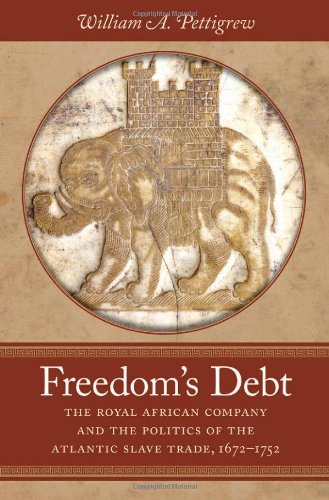
In the years following the Glorious Revolution, independent slave traders challenged the charter of the Royal African Company by asserting their natural rights as Britons to trade freely in enslaved Africans. In this comprehensive history of the rise and fall of the RAC, William A. Pettigrew grounds the transatlantic slave trade in politics, not economic forces, analyzing the ideological arguments of the RAC and its opponents in Parliament and in public debate. Ultimately, Pettigrew powerfully reasons that freedom became the rallying cry for those who wished to participate in the slave trade and therefore bolstered the expansion of the largest intercontinental forced migration in history.
Unlike previous histories of the RAC, Pettigrew’s study pursues the Company’s story beyond the trade’s complete deregulation in 1712 to its demise in 1752. Opening the trade led to its escalation, which provided a reliable supply of enslaved Africans to the mainland American colonies, thus playing a critical part in entrenching African slavery as the colonies’ preferred solution to the American problem of labor supply.