[Economy] Videos
Debt is often thought of as a mere economic variable governed by a simplistic mechanical logic, ignoring its other facets. Whose debt, and debt of what exactly? This volume analyzes debt as a political and social construct, with a multiplicity of purposes and agents. All of these are vectors of meanings that are highly diverse, and of subtle distinctions; they show that debt is a transverse phenomenon, cutting across spaces that are not merely economic but also domestic, social and political. Each contributor takes a fresh view of the subject, dealing with debt at a different time, in a different society, on a different scale of observation. By adopting a determinedly interdisciplinary approach, the authors reveal in the phenomenon of debt a diversity of social and gendered determinants that amount in some cases to domination, allegiance or slavery, and in others to solidarity and emancipation. Debt is at one and the same time shared, imposed, political and gendered.
Gambling Debt is a game-changing contribution to the discussion of economic crises and neoliberal financial systems and strategies. Iceland’s 2008 financial collapse was the first case in a series of meltdowns, a warning of danger in the global order. This full-scale anthropology of financialization and the economic crisis broadly discusses this momentous bubble and burst and places it in theoretical, anthropological, and global historical context through descriptions of the complex developments leading to it and the larger social and cultural implications and consequences.
Chapters from anthropologists, sociologists, historians, economists, and key local participants focus on the neoliberal policies?mainly the privatization of banks and fishery resources?that concentrated wealth among a select few, skewed the distribution of capital in a way that Iceland had never experienced before, and plunged the country into a full-scale economic crisis. Gambling Debt significantly raises the level of understanding and debate on the issues relevant to financial crises, painting a portrait of the meltdown from many points of view?from bankers to schoolchildren, from fishers in coastal villages to the urban poor and immigrants, and from artists to philosophers and other intellectuals.
This book is for anyone interested in financial troubles and neoliberal politics as well as students and scholars of anthropology, sociology, economics, philosophy, political science, business, and ethics.
Publication supported in part by the National Science Foundation.
Contributors:
Vilhjálmur Árnason, Ásmundur Ásmundsson, Jón Gunnar Bernburg, James Carrier, Sigurlína Davíðsdóttir, Dimitra Doukas, Níels Einarsson, Einar Mar Guðmundsson, Tinna Grétarsdóttir, Birna Gunnlaugsdóttir, Guðný S. Guðbjörnsdóttir, Pamela Joan Innes, Guðni Th. Jóhannesson, Örn D. Jónsson, Hannes Lárusson, Kristín Loftsdóttir, James Maguire, Már Wolfgang Mixa, Evelyn Pinkerton, Hulda Proppé, James G. Rice, Rögnvaldur J. Sæmundsson, Unnur Dís Skaptadóttir, Margaret Willson
For decades, politicians and business leaders alike told the American public that our most important challenge was growing the economy, and that environmental protection could be left to future generations. Now, in the wake of billions of dollars in costs associated with coastal devastation from Hurricane Sandy, rampant wildfires across the West, and groundwater contamination from reckless drilling, it’s increasingly clear that yesterday’s carefree attitude about the environment has morphed into a fiscal crisis of epic proportions. Environmental Debt argues that the costs of global warming, extreme weather, pollution, and other forms of “environmental debt” are wreaking havoc on the economy. To combat these trends, author Amy Larkin proposes a new framework for twenty-first century commerce, based on three principles: 1) Pollution can no longer be free; 2) All business decision making and accounting must incorporate the long view; and 3) Government must play a vital role in catalyzing clean technology and growth while preventing environmental destruction. Profiling the multinational corporations that are transforming their operations with downright radical initiatives, Larkin presents smart policy choices that would actually unleash these business solutions to many global financial and environmental problems.
From personal finance and consumer spending to ballooning national expenditures on warfare and social welfare, debt is fundamental to the dynamics of global capitalism. The contributors to this volume explore the concept of indebtedness in its various senses and from a wide range of perspectives. They observe that many views of ethics, citizenship, and governance are based on a conception of debts owed by one individual to others; that artistic and literary creativity involves the artist’s dialogue with the works of the past; and that the specter of catastrophic climate change has underscored the debt those living in the present owe to future generations.
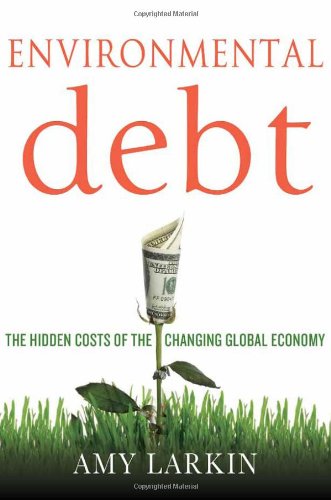
An award-winning environmental activist and social entrepreneur exposes the link between our financial and environmental crises
For decades, politicians and business leaders alike told the American public that today’s challenge was growing the economy, and that environmental protection could be left to future generations. Now in the wake of billions of dollars in costs associated with coastal devastation from Hurricane Sandy, rampant wildfires across the West, and groundwater contamination from reckless drilling, it’s becoming increasingly clear that yesterday’s carefree attitude about the environment has morphed into a fiscal crisis of epic proportions.
Amy Larkin has been at the forefront of the fight for the environment for years, and in Environmental Debt she argues that the costs of global warming, extreme weather, pollution and other forms of “environmental debt” are wreaking havoc on the economy. Synthesizing complex ideas, she pulls back the curtain on some of the biggest cultural touchstones of the environmental debate, revealing how, for instance, despite coal’s relative fame as a “cheap” energy source, ordinary Americans pay $350 billion a year for coal’s damage in business related expenses, polluted watersheds, and in healthcare costs. And the problem stretches far beyond our borders: deforestation from twenty years ago in Thailand caused catastrophic flooding in 2011, and cost Toyota 3.4 percent of its annual production while causing tens of thousands of workers to lose jobs in three different countries.
To combat these trends, Larkin proposes a new framework for 21st century commerce, based on three principles: 1) Pollution can no longer be free; 2) All business decision making and accounting must incorporate the long view; and 3) Government must play a vital role in catalyzing clean technology and growth while preventing environmental destruction. As companies and nations struggle to strategize in the face of global financial debt, many businesses have begun to recognize the causal relationship between a degraded environment and a degraded bottom line. Profiling the multinational corporations that are transforming their operations with downright radical initiatives, Larkin presents smart policy choices that would actually unleash these business solutions to many global financial and environmental problems.
Provocative and hard-hitting, Environmental Debt sweeps aside the false choices of today’s environmental debate, and shows how to revitalize the economy through nature’s bounty.
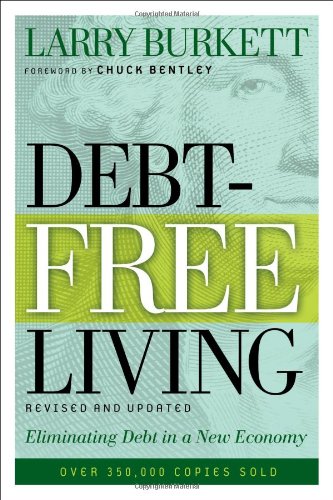
So much has changed…and yet, so much is exactly the same. Debt-Free Living has sold more than 300,000 copies in the two decades since Larry Burkett first laid down the challenge to live debt-free lives. And now, on the heels of the debt-fueled debacle that was 2008-2009, we need this message now more than ever.
With people’s credit, mortgages, car payments, salaries, commissions, and bills fluctuating daily, Debt-Free Living has never looked more attractive. This bestselling book has been updated and revised to reflect today’s realities alongside timeless biblical truth. Learn about the origin of most financial troubles and break out of the debt cycle. Debt-Free Living is a necessary resource to battle the ever-present temptation and trappings of more and more debt that keep weighing you down.