[Global] Videos
From the authors who accurately predicted the bursting of the global bubble economy comes the definitive look at what lies ahead in 2013 and beyond
Written by the market oracles who predicted, with uncanny accuracy, the global financial meltdown and the economic chain reaction it set in motion, Aftershock offers a vivid picture of what to expect when the world’s bubble economy inevitably pops. More importantly, it tells you how to protect your assets before and during the coming Aftershock and how to capitalize on the new opportunities that others will miss.
Building on the valuable insights and proven predictions of their previous books, the authors of Aftershock, Third Edition offer their latest thinking and advice as the economy moves even closer to the coming aftershock. Explains why and how the stock market, real estate, consumer spending, private debt, dollar, and government debt bubbles will burst, driving up unemployment, devaluing the dollar, and causing deep recession around the globe Updated to include the latest developments, such as new coverage of monetary stimulus and a more global focus (with special attention to Europe and China)Offers new actionable insights about protection and profits in an increasingly confusing investment environment
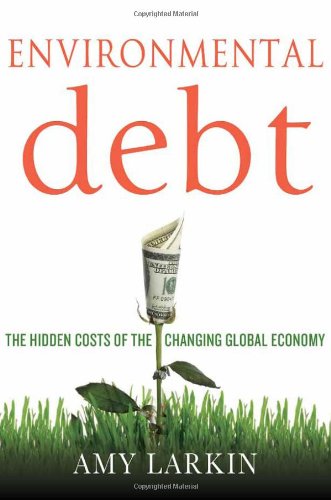
An award-winning environmental activist and social entrepreneur exposes the link between our financial and environmental crises
For decades, politicians and business leaders alike told the American public that today’s challenge was growing the economy, and that environmental protection could be left to future generations. Now in the wake of billions of dollars in costs associated with coastal devastation from Hurricane Sandy, rampant wildfires across the West, and groundwater contamination from reckless drilling, it’s becoming increasingly clear that yesterday’s carefree attitude about the environment has morphed into a fiscal crisis of epic proportions.
Amy Larkin has been at the forefront of the fight for the environment for years, and in Environmental Debt she argues that the costs of global warming, extreme weather, pollution and other forms of “environmental debt” are wreaking havoc on the economy. Synthesizing complex ideas, she pulls back the curtain on some of the biggest cultural touchstones of the environmental debate, revealing how, for instance, despite coal’s relative fame as a “cheap” energy source, ordinary Americans pay $350 billion a year for coal’s damage in business related expenses, polluted watersheds, and in healthcare costs. And the problem stretches far beyond our borders: deforestation from twenty years ago in Thailand caused catastrophic flooding in 2011, and cost Toyota 3.4 percent of its annual production while causing tens of thousands of workers to lose jobs in three different countries.
To combat these trends, Larkin proposes a new framework for 21st century commerce, based on three principles: 1) Pollution can no longer be free; 2) All business decision making and accounting must incorporate the long view; and 3) Government must play a vital role in catalyzing clean technology and growth while preventing environmental destruction. As companies and nations struggle to strategize in the face of global financial debt, many businesses have begun to recognize the causal relationship between a degraded environment and a degraded bottom line. Profiling the multinational corporations that are transforming their operations with downright radical initiatives, Larkin presents smart policy choices that would actually unleash these business solutions to many global financial and environmental problems.
Provocative and hard-hitting, Environmental Debt sweeps aside the false choices of today’s environmental debate, and shows how to revitalize the economy through nature’s bounty.