[Need] Videos

— Created using PowToon — Free sign up at http://www.powtoon.com/youtube/ — Create animated videos and animated presentations for free. PowToon is a free tool that allows you to develop cool animated clips and animated presentations for your website, office meeting, sales pitch, nonprofit fundraiser, product launch, video resume, or anything else you could use an animated explainer video. PowToon’s animation templates help you create animated presentations and animated explainer videos from scratch. Anyone can produce awesome animations quickly with PowToon, without the cost or hassle other professional animation services require.
Is there such thing as good debt? And how could something good cause so many issues? On top of this is there anyway that we could just run an economy without debt and would we be better off for doing so. Well it turns out we probably can, and in fact there are many economies around the world today that are developing rapidly while going without this system that we just assume is a given.
If we can critically explore these questions it will offer insight into how our modern financial system works, and why it means that despite our best efforts we are almost destined to go into a recession once every 10 years or so.
#debtcrisis #recession #economy
Patreon – https://www.patreon.com/EconomicsExplained
Discord – https://discord.gg/7kM7Tw9
Enquiries – loungejita@gmail.com
Money printer meme video – https://youtu.be/O1hCLBTD5RM
second channel for Q&A Streams – https://www.youtube.com/channel/UCOTgNyfQG4vVP5sCXrJaS4g?view_as=subscriber
References –
Harris, M. and Raviv, A., 1990. Capital structure and the informational role of debt. The Journal of Finance
Chava, S. and Roberts, M.R., 2008. How does financing impact investment? The role of debt covenants. The journal of finance
Holmstrom, B., 2015. Understanding the role of debt in the financial system.
Frost, C.A. and Bernard, V.L., 1989. The role of debt covenants in assessing the economic consequences of limiting capitalization of exploration costs. Accounting Review
Ariff, M., 1988. lsIamic banking. Asian?Pacific Economic Literature
Articles –
https://www.theguardian.com/business/2019/jan/05/global-economic-crash-2020-understand-why
https://www.washingtonpost.com/
https://www.theguardian.com/business/2019/dec/29/its-more-than-a-decade-since-the-financial-crisis-wheres-the-recovery
Graham’s Video – https://www.youtube.com/watch?v=Uw3EhsmLe08&t=1385s

IG – http://bit.ly/2SptcAL
? In this video, we’re going to learn ten important lessons about debt relief. Leave your thoughts or questions in the comments below. Have fun!
? SUBSCRIBE FOR MORE FINANCIAL EDUCATION
https://www.youtube.com/channel/UC4y7a8nzB3W9IWd71FHnOsw/?sub_confirmation=1
What is Build Your Tomorrow?
Build Your Tomorrow is financial fitness for all.
Join our newsletter for giveaways and exclusive content:
http://bit.ly/2Fc98Q7
Instagram: _buildyourtomorrow
Website: www.buildyourtomorrow.com
Let’s connect: eliezer@buildyourtomorrow.com
Hashtag: #buildyourtomorrow
Home base: New York
*The content contained on or made available through this website is not intended to and does not constitute financial or investment advice. Your use of the information on this channel or materials linked from the Web is at your own risk.

The Debt Counsellor is appointed by the NCR set out by the National Credit Act. (section 44.(2) A person must not offer or engage in the services of a debt counsellor in terms of this Act, or hold themselves out to the public as being authorised to offer any such service, unless that person is registered as such in terms of this Chapter
The Debt Counsellor may be reprimanded by the regulator if he/she does not work in the frame work set out by the regulator and the NCA
Learn how to get control of your debt with tips from an industry insider who has worked as a debt collector for over 24 years and who has been in debt herself and had to deal with aggressive debt collectors.
“Beverly Harzog is a credit warrior. She has gone into the arena, faced the lions, and emerged as one of the foremost experts in the field. I believe that her encyclopedic knowledge of the world of credit cards is unmatched.”
-Adam Levin, Chairman and Cofounder, Credit.com
Credit card expert Beverly Harzog shares how she went from being a credit card disaster to a credit card diva.
When Beverly got out of college, she spent the next 10 years racking up debt on seven credit cards. Credit card limits, she believed, were merely “guidelines,” certainly not anything to be taken seriously. . .especially if she was in dire need of a new pair of shoes. The fact that she was a Cpa at the time adds an ironic twist to the credit quagmire she slowly descended into.
In Confessions of a Credit Junkie, Beverly candidly details her own credit card mishaps and offers easy-to-follow advice, often with a touch of Southern humor, to help others avoid them. In this much-needed book, you’ll learn:
How to use the Credit Card Personality Quiz to choose the right credit cards
The seven ways to use a credit card to rebuild credit
How to get out of debt using a balance transfer credit card-and pay zero interest while doing it
Credit card strategies to save a bundle on groceries, gas, and more
Anyone in debt will benefit from the down-to-earth, practical tips Beverly offers.
Getting Your FREE Bonus
Download this book, read it to the end and see “BONUS: Your FREE Gift”chapter after the conclusion.
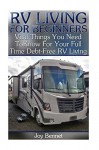
RV Living For Beginners:(FREE Bonus Included) Vital Things You Need To Know For Your Full Time Debt-Free RV Living
A guide that doesn’t disappoint, this book walks you through the fundamentals of RV’s and then some. These pages inform you of just how you can begin a lifetime of excitement traveling all over the country in your Recreational Vehicle while making sure that you live a life that is debt free.
Whether you are roughing it or more of a Glamper this book has everything you need to know to be able to live well within your means.
RV’s are called “Recreational Vehicles” because many wish to only take them out every once in a while, during the holiday or summer vacation excursions.
But these RV’s can be much more than recreational, they can be your fulltime home no matter where you park them, and this book teaches you how!
In this book we will learn about:
RV Maintenance Streamlining your Trip How to Keep a Budget Fuel Economy Free and Discount Parking And much more!
Download your E book ” RV Living For Beginners: Vital Things You Need To Know For Your Full Time Debt-Free RV Living ” by scrolling up and clicking “Buy Now with 1-Click” button!
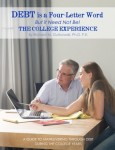
As their children grow up parents face increasing need to develop and guide their wise formal use of money. In the teen years, acquiring a credit card is a first foray. Then purchasing a first auto comes along. As post-secondary education nears, student loans arise. Graduation moves a better auto and a first condo or home purchase to the horizon. Increasing complexity and monetary magnitude of loan needs can be a scary challenge for people relatively new to debt.
Debt is a 4-Letter Word, but it need not be! is a book series that helps parents and young people to effectively maneuver through first-time debt worries. In The College Experience the reader walks along as a fictionalized Dad and daughter go through her independent need for a credit card for ongoing college expenses, financing her college dreams, considering graduate school, and planning for post-graduation repayment of student loans. One observes Dad’s caring teaching path; taken atop informed, strategic borrowing strategies he shares and uses as they make important decisions and take vital steps together. You see a parent become less and less overseeing and a daughter more and more self-reliant.
Debt is a 4-Letter Word, but it need not be! The College Experience volume includes:
• 20 LESSONS about typical college-related debt needs young families face
• 42 detailed hypothetical SITUATIONS numerically covering borrowing circumstances commonly encountered in real life college experiences
• Step-by-step explanation of needed calculation techniques
• 39 easy-to-do EXERCISES for the reader to try the illustrated calculation methods
• Table-based aids to simplify/expedite applying the detailed calculations procedures
While pragmatic and detailed, the book is written in a fun, narrative style so the reader will enjoy learning what otherwise might be unexciting financial matters.
The Eurozone crisis which started in spring 2010 as a Greek budget crisis has alerted Europeans that the issue of defaulting sovereigns is not one reserved just for the poor and poorest countries on this globe. The crisis painfully amplified that developed countries, too, might be hit by this phenomenon. To be sure, this insight is far from novel – the history of defaulting states reaches back into history for at least two millennia. And yet, lawyers have surprisingly abstained more or less completely from discussing this subject and developing possible solutions. Beginning with the Argentina crisis in 2001, this neglect began to vanish to a certain degree and this movement got some momentum in 2010 by the Eurozone crisis. The present book collects contributions from authors, most of whom have participated in a conference on this issue in January 2012 at the Humboldt-Universität zu Berlin. The presentations, thus, provide a unique overview of the present discussion both from an economic and legal perspective.
Put the most valuable business tool to work for you!
The balance sheet is the key to everything–from efficient business operation to accurate assessment of a company’s worth. It’s a critical business resource–but do you know how to read it? How to Read a Balance Sheet breaks down the subject into easy-to-understand components.
If you’re a business owner or manager, this book helps you . . . Manage working capital Generate higher returns on assets Maximize your inventory dollars Evaluate investment opportunities
If you’re an investor, this book helps you . . . Determine the market value of a company’s assets and operations Predict future earnings and trends Assess the impact of capital expenditures Identify potential “red flags” before the crowd
How to Read a Balance Sheet gives you the bottom line of what you need to know about:
Cash Flow * Assets * Debt * Equity * Profit and how it all comes together.