Most Viewed Videos
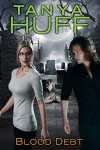
It began with a ghost in his bedroom. A tormented soul hungry for vengeance. The sort of nocturnal visitation that even a five-hundred-year-old vampire like Henry Fitzroy found tiresome. It would lead Vicki Nelson, PI into her most deadly investigation yet. The wraith is determined that Henry and Vicki track down its killer – and is prepared to use a little persuasion by way of the innocent inhabitants of Toronto to ensure their support. Forced to investigate, Vicki discovers a host of souls in desperate torment and evidence to suggest that trailing the killer will only lead to further deaths – starting with her own.

The Trump administration has made some changes to the program that allows private citizens to make contributions to pay down our $36 TRILLION national debt. The administration has apparently added options to allow citizens to send “gifts” using Venmo and PayPal. The program has actually existed for nearly 30 years, and during that time it hasn’t made a dent in the program, but the Trump administration seems to think that modernizing the payment system will get the cash flow started. Ring of Fire’s Farron Cousins discusses this.
Link – https://newrepublic.com/post/198329/venmo-pay-national-debt
Subscribe to stay connected to our stories: https://www.youtube.com/theringoffire
Support us by becoming a member on YouTube: https://www.youtube.com/channel/UCYWIEbibRcZav6xMLo9qWWw/join
Or Support us on Patreon: https://www.patreon.com/TheRingofFire
Buy Ring of Fire merch: https://www.buyrof.com/
Find us on social media!
Facebook: http://www.facebook.com/RingofFireRadio
Twitter: https://twitter.com/RingofFireMedia
Instagram: https://www.instagram.com/ringoffirenetwork/
TikTok: https://www.tiktok.com/@ringoffiremedia
*This transcript was generated by a third-party transcription software company, so please excuse any typos.
Hey folks, if you’ve got an extra $36 trillion lying around that, you don’t need good news, you can now take your $36.65 trillion and simply Venmo it to the federal government. And boom, we’ve paid off our national debt. Because according to a new report from NPR, they uncovered this. The Trump administration has now opened up Venmo and PayPal payments so that average everyday citizens can send gifts of money to the federal government that will be used to pay off again, the $36.65 trillion national debt. Now, for the record, this program is not new. In fact, it didn’t even start under Trump. It didn’t even start under a Republican back in 1996. Uh, the federal government under Bill Clinton actually opened up to, uh, start receiving gifts of money from average citizens to help pay down the national debt. So this program has been going on for 29 years.
It’s just that the Trump administration has now modernized it, and you don’t have to send in a check anymore. You can hop on Venmo or PayPal and immediately get that money to the federal government without having to wait on the US mail to deliver your check. So they want that money, they want it now, they want it fast. They’ve added Venmo and PayPal. And for the record, in the 29 years that this program has been in existence, the federal government has only brought in $67 million. I say only that’s a lot of money. I mean, for everybody watching this, that’s a life changing amount of money. But when you’re $36.65 trillion in debt, 67 million really isn’t gonna do anything. But I don’t know, maybe people were waiting for Venmo and PayPal. Maybe Donald Trump has stumbled upon the greatest idea ever in the history of ideas. Or maybe this is a way for the Trump administration to take your money and go spend it on things that are not in fact the national debt, uh, don’t necessarily know, but wouldn’t surprise me. But here’s the thing, like not only is this just stupid, like on its face, the fact that this has existed for 29 years is dumb, like very, very dumb. But what’s even dumber, and of course, a little more cruel is putting it on you, right? You listening to me talk right now, you are not responsible for the national debt, okay? You are not the one that spent that money, the federal government did. And it’s not that they spent 60 or, you know, 36 million what, or trillion,
Whatever. They didn’t spend 36 trillion to make your life better, okay? If they had done that, that would be a reasonable justifiable expense. We’ve spent $36 trillion creating chaos around the planet, killing civilians, destroying landscapes, absolutely changing the way the earth looks with missiles and tanks and bombs. That’s where that $36 trillion went. It didn’t go to people on Medicaid, it didn’t go to people on food stamps. It didn’t go to Medicare, it didn’t go to Social Security. It went to help destroy lives all over the world, and it continues to go there every single day. So it is not on you. You should not have to Venmo the federal government money because they have spent unwisely for decades and decades and decades. That’s what me off about this story. The audacity of these people who go into office and vote for these horrible budgets, approve these, you know, world changing attacks that we launch. Those are the people that ought to be losing their paychecks to pay down this national debt. You wanna vote for this? You wanna spend trillions of dollars on this crap? Then they, those elected officials are the ones who need to pay up, not the average US citizen.

Sow a Seed and watch it grow! To find out more about how you can see MIRACLES HAPPEN in your finances visit JoanHunter.org

Join the Exclusive Besties club here for all the exclusive content:
https://www.youtube.com/channel/UC_GbpCRxCyP8kzx6bge593Q/join
Baked by Opy instagram page: https://www.instagram.com/baked_by_opy/
—————- Follow us here ————-
Instagram – https://instagram.com/oleratoandfamily
Facebook – https://www.facebook.com/MnBapproved
#marriage #and #money
PRODUCTS WE LOVE & USE
Vlog Camera We Use:
Canon G7x Mark ii
Old Vlog Camera
Canon powershot G9x
Polaroid Cameras:
Instax mini 8
Polaroid Snap touch
Hi Besties.
Welcome to our channel. I’d like to believe that this is a space were parenting is made fun and memories are created on a daily. I am a career girl turned working Mom and I love it.
*Disclaimer*
Videos uploaded on this channel are private videos,please refrain from downloading and using them without my consent.

Deciding between a balance transfer credit card and a debt consolidation loan depends on the terms you get, the repayment plan, and your comfort with risk. A balance transfer credit card is a great option if you can get a 0% introductory APR, AND you can pay off the balance before the period expires. A debt consolidation loan might be better if you need a more extended period to pay off the debt.
So, when thinking about debt consolidation, you need to think about these things:
1. Are you just kicking debt down the road? Meaning ae you paying off debt by taking out more debt? You have to lower your spending and be committed to not accruing more debt as you work on paying off
your debt.
2. If you have a low credit score, you probably won't be able to get a lower interest rate on the balance transfer or debt consolidation loan. So, first focus on making on-time payments, paying off debt, and increasing your credit score.
3. make sure you have a budget and have found a way for that budget to work successfully in your life.
Now, of course, I always recommend paying off your debt by buckling down, controlling your spending, and learning about why you are debt in the first place. Addressing and understanding why you go into
debt is critical if you want to make changes to stay out of debt in the future.
That said, when you are facing financial hardship, sometimes debt consolidation can help when you have high-interest debt that is not manageable.
CHAPTERS
Intro: 00:00
What is debt consolidation: 00:54
The benefits: 01:45
How to consolidate your debt: 03:23
Things to consider: 09:55
?? SHOULD YOU CONSOLIDATE YOUR DEBT: https://bit.ly/3e69JAv
?? SHOULD YOU CONSOLIDATE STUDENT LOANS: https://bit.ly/3oy9xPw
?? FINDING YOUR WHY: https://bit.ly/3aJUryj
?? THE BUDGET MOM’S FINANCIAL FREEDOM STEPS: https://bit.ly/3cfJXsp
?? HOW TO GET STARTED WITH THE CASH ENVELOPE METHOD: https://bit.ly/2vQJaO5
?? HOW TO CREATE A PLAN OF ATTACK TO PAY OFF DEBT: https://bit.ly/2wDETxF
ABOUT ME
I’m the blogger behind https://www.thebudgetmom.com. I have a rambunctious 6-year-old son, live in Washington, and I’m passionate about helping people with money management and personal finance. Let me know what you like to learn more about! Leave me comments and suggestions on my video and let me know!
YOU CAN FIND ME AT:
? BLOG: https://www.thebudgetmom.com
? FACEBOOK: https://www.facebook.com/thebudgetmom/
? INSTAGRAM: https://www.instagram.com/thebudgetmom/
? PINTEREST: https://www.pinterest.com/thebudgetmom/
GET STARTED
??Start Here: https://www.thebudgetmom.com/start-here/
??Free Email Course: https://bit.ly/2UYgNFf
??Free Resources: https://bit.ly/2PDmTHz
??GET 10% OFF my popular Budget-by-Paycheck Workbook – Coupon Code TBMYOUTUBE https://bit.ly/2CR7U9n
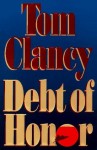
Every novel by Tom Clancy has been “a jaw-tightener and a nail-biter of the first order,” as the San Diego Union described Without Remorse. But Debt of Honor surpasses them all, with Jack Ryan facing his greatest challenge-against a periil that may become all too real. Debt of Honor is Tom Clancy’s most timely and gripping novel yet. Filled with the exceptional realism and intricate plotting that are his hallmarks, it attests to the world of the St. Louis Post-Dispatch: “The man can tell a story.”
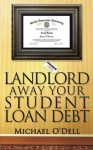
“Easy to read and hard to put down! Interesting and informative!” Get someone else to pay for your education. Landlord Away Your Student Loan Debt chronicles the path I took which made every student loan payment for me and put a few bucks in my pocket to boot. My strategy was simple: Pay off student loan debt with real estate. I have never made a student loan payment with my own money. I’m sorry to say I don’t have any gimmicky system to sell you. If you read this book, you will be equipped to start your journey toward financial freedom. You will be given advice, Internet search criteria, and suggested readings throughout this text. You will also be able to experience several pitfalls that plagued me while I established myself in the landlord business. I neutralized over $200,000.00 of student loan debt without using any of my own money! I turned paying my student loans into a game and I smile every month when the money is drafted out of an account that I didn’t fund (my tenants funded it for me). This book features lots of advice from a seasoned landlord, web searches for useful information, a primer on student loan repayment, and a great story. A lot of effort has gone into making this book an “easy read.” I purposefully left out as much business, landlording, and real estate jargon as possible. The approach taken assumes that the reader is not a seasoned landlord, or an expert regarding student loans.
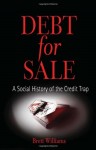
Credit and debt appear to be natural, permanent facets of Americans’ lives, but a debt-based economy and debt-financed lifestyles are actually recent inventions. In 1951 Diners Club issued a plastic card that enabled patrons to pay for their meals at select New York City restaurants at the end of each month. Soon other “charge cards” (as they were then known) offered the convenience for travelers throughout the United States to pay for hotels, food, and entertainment on credit. In the 1970s the advent of computers and the deregulation of banking created an explosion in credit card use—and consumer debt. With gigantic national banks and computer systems that allowed variable interest rates, consumer screening, mass mailings, and methods to discipline slow payers with penalties and fees, middle-class Americans experienced a sea change in their lives.
Given the enormous profits from issuing credit, banks and chain stores used aggressive marketing to reach Americans experiencing such crises as divorce or unemployment, to help them make ends meet or to persuade them that they could live beyond their means. After banks exhausted the profits from this group of people, they moved into the market for college credit cards and student loans and then into predatory lending (through check-cashing stores and pawnshops) to the poor. In 2003, Americans owed nearly $8 trillion in consumer debt, amounting to 130 percent of their average disposable income. The role of credit and debt in people’s lives is one of the most important social and economic issues of our age.
Brett Williams provides a sobering and frank investigation of the credit industry and how it came to dominate the lives of most Americans by propelling the social changes that are enacted when an economy is based on debt. Williams argues that credit and debt act to obscure, reproduce, and exacerbate other inequalities. It is in the best interest of the banks, corporations, and their shareholders to keep consumer debt at high levels. By targeting low-income and young people who would not be eligible for credit in other businesses, these companies are able quickly to gain a stranglehold on the finances of millions. Throughout, Williams provides firsthand accounts of how Americans from all socioeconomic levels use credit. These vignettes complement the history and technical issues of the credit industry, including strategies people use to manage debt, how credit functions in their lives, how they understand their own indebtedness, and the sometimes tragic impact of massive debt on people’s lives.
Product Features
- Used Book in Good Condition
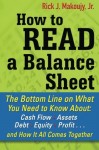
Put the most valuable business tool to work for you!
The balance sheet is the key to everything–from efficient business operation to accurate assessment of a company’s worth. It’s a critical business resource–but do you know how to read it? How to Read a Balance Sheet breaks down the subject into easy-to-understand components.
If you’re a business owner or manager, this book helps you . . . Manage working capital Generate higher returns on assets Maximize your inventory dollars Evaluate investment opportunities
If you’re an investor, this book helps you . . . Determine the market value of a company’s assets and operations Predict future earnings and trends Assess the impact of capital expenditures Identify potential “red flags” before the crowd
How to Read a Balance Sheet gives you the bottom line of what you need to know about:
Cash Flow * Assets * Debt * Equity * Profit and how it all comes together.
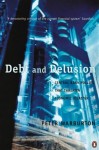
There is an unexploded bomb in the global financial system, threatening to bring the greatest disruption to the lives of people since the Depression on the 1930s. This potential explosion has been created by dereliction of duty by the world’s largest central banks, which have helped to create an unsustainable illusion of personal wealth and national prosperity, exposing the public to uninsurable risks in the process. This volume looks at how this economic timebomb has been created by unchecked credit expansion and the potential havoc it could wreak.