Most Viewed Videos
This little book about the Bible grew out of lectures which the writer delivered on the subject to mixed audiences. The lectures were afterwards expanded, and appeared in a series of articles in the Catholic press 1908-9, and are now with slight alterations reprinted. Their origin will sufficiently account for the colloquial style employed throughout. There is, therefore, no pretence either of profound scholarship or of eloquent language; all that is attempted is a popular and, as far as possible, accurate exposition along familiar lines of the Catholic claim historically in regard to the Bible. It is candidly controversial without, however, let us hope, being uncharitable or unfair. Friends had more than once suggested the reissue of the articles; and it appeared to the writer that at last the proper moment for it had come when the Protestant world is jubilating over the Tercentenary of the Authorised Version. Amidst the flood of literature on the subject of the Bible, it seemed but right that some statement, however plain and simple, should be set forth from the Catholic side, with the object of bringing home to the average mind the debt that Britain, in common with the rest of Christendom, owes to the Catholic Church in this connection. Henry G Graham
In the wake of the global financial crisis, most of the discussion has been focused on questions of debt. And the response, almost uniformly, has been austerity and privatization: cuts to services that have been painted as forms of reckless spending by a bloated public sector. In Debt or Democracy, Mary Mellor turns the whole conversation upside down, showing that the important question is not who owes what, but who controls the creation and circulation of money in the first place. When the problem is examined from that angle, it becomes clear that privatization, far from being the answer to our problem, is the very source of it—the subordination of public finance to private interest.
A direct challenge to conventional economic thinking, Debt or Democracy offers a bracing new analysis of our economic crisis and offers cogent, radical alternatives to create a more just and sustainable economic future.

The National Credit Amendment Bill aims to provide relief to low-income earners, by erasing part or all of their debt.
For more on this, we’re joined by Norton Rose Fulbright Attorney’s Riccardo Petersen.
Courtesy #Dstv403
This book is specifically designed for 8th through 10th graders who want to have a successful high school experience that leads to success in college and ultimately getting a job. It can be equally helpful for older high school students and college freshman, although they will have some catching up to do. Are you struggling with high school or confused and wondering how you should approach and pay for college? This book guides you through high school strategies to prepare for college. It leads you through the right way to survive college without borrowing money while getting prepared for a real-world career and actually getting a job in your field once you graduate. The advice in this book is based on 30 years of business experience and experiences teaching and coaching over 2,000 high school students. The advice is real world… what’s going to happen when someone is paying you rather than when you are paying them. Let the ideas in this book help you to focus your efforts and make decisions that will lead to an exciting career that makes sense for you. All of this all without incurring massive college debts that control your life decisions and restrict your choices!
THE FRUGAL LIFESTYLE: How to Save Money, Declutter Your Life and Live a Debt Free Lifestyle Do you want to get out of debt once and for all? Are you tired of living from paycheck to paycheck, feeling like you never have quite enough? With this book, you have a comprehensive guide to doing a complete overhaul of your financial situation from debt relief to retirement planning and everything in between. You will even learn how to do a professional assessment of your finances so that you can see exactly what you have to work with and how to construct a plan uniquely suited to your needs. After reading this guide to frugal living, you won’t need to spend extra money that you don’t have on a professional financial advisor. Discover how to live frugally and free yourself from debt painlessly Also, you’ll discover.. Simple lifestyle changes that will eliminate clutter and save you money. Proven investment strategies that you can use to earn more money. How you can build a savings no matter how tight your budget is. And much more! Table of Contents Chapter 1: Do it Yourself Financial Assessment Learn how to do a financial assessment like a pro so you can see exactly where you stand as of now. Chapter 2: Freeing Yourself from Debt Read about strategies for managing your debt and becoming totally debt free Chapter 3: Planning Your Dream Retirement Get tips and tricks for planning for the retirement you always dreamed of. Chapter 4: A Brief Guide to Wall Street Learn the basics of investing and how to build an investment portfolio with low risk and high reward. Chapter 5: Savings 101 Everything you need to know about building a savings in any situation Chapter 6: Minimalism for Maximum Gain How to cut your expenses by eliminating clutter and knowing your priorities Chapter 7: Budgeting for Freedom All you need to know to create your own budget for getting out of debt, saving money, and achieving financial freedom
Preparing for college is an exciting time of life, but I know it can be dampened by the mountain-sized financial obstacles standing between you and the college experience of your dreams.
The many parents and student athletes I speak with today are in the exact same boat. They want to know what to expect throughout their college journey. They crave more knowledge, they want to know they’re on the right track, and they want an amazing college tenure that doesn’t leave them high and dry financially.
Well hindsight is 20/20, and I’m excited to share insights with you to ensure you have the best college experience possible. By the end of our time together you will have the training you’ll need to graduate completely debt-free. That means no student-loans, no parent-loans, and freedom after graduation to live your calling and change the world.
See you inside!
Many families want to adopt, but do not have the large amount of money it takes to complete a private domestic or international adoption. Some quickly give up the idea of adopting and are left feeling frustrated, overwhelmed, and discouraged. Those who choose to proceed often take out large loans or borrow from family and friends which adds to the financial pressure on the family. Author Julie Gumm shares proven strategies from her own experience as well as from others that include applying for grants, creative budgeting, and fundraising that prospective adoptive parents can use to prepare for and avoid those high costs associated with adoption.
Although banking and sovereign debt crises are not unusual, the crisis that has unfolded across the world since 2007 has been unique in both its scale and scope. It has also been unusual in being both triggered by, and mainly affecting, developed economies. Starting with the US subprime mortgage crisis, and the recession in 2007-2009, the problem soon erupted into financial crisis in Europe. A few of these countries came to the brink of bankruptcy, and were rescued by the EU and the IMF on the condition they adopt austerity measures. The detrimental social effects of the crisis in both the US and Europe are still emerging.
Although there have been several studies published on the US crisis in particular, there has so far been an absence of an accessible comparative overview of both crises. This insightful text aims to fill this gap, offering a critical overview of causes, policy responses, effects and future implications. Starting with the historical context and mutation of the crisis, the book explores the policies, regulations, and governance reforms that have been implemented to cope with the US subprime mortgage crises. A parallel analysis considers the causes of the European sovereign debt crisis and the responses of the European Union (EU), examining why the EU is as yet unable to resolve the crisis. This book is supported with eResources that include essay questions and class discussion questions in order to assist students in their understanding.
This uniquely comprehensive and readable overview will be of interest and relevance to those studying financial crises, financial governance, international economics and international political economy.
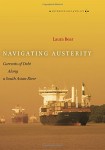
Navigating Austerity addresses a key policy question of our era: what happens to society and the environment when austerity dominates political and economic life? To get to the heart of this issue, Laura Bear tells the stories of boatmen, shipyard workers, hydrographers, port bureaucrats and river pilots on the Hooghly River, a tributary of the Ganges that flows into the Bay of Bengal and Indian Ocean. Through their accounts, Bear traces the hidden currents of state debt crises and their often devastating effects.
Taking the reader on a voyage along the river, Bear reveals how bureaucrats, entrepreneurs and workers navigate austerity policies. Their attempts to reverse the decline of ruined public infrastructures, environments and urban spaces lead Bear to argue for a radical rethinking of economics according to a social calculus. This is a critical measure derived from the ethical concerns of people affected by national policies. It places issues of redistribution and inequality at the fore of public and environmental plans. Concluding with proposals for restoring more just long term social obligations, Bear suggests new practices of state financing and ways to democratize fiscal policy. Her aim is to transform sovereign debt from a financial problem into a widely debated ethical and political issue. Navigating Austerity contributes to policy studies as well as to the understanding of today’s global injustices. It also develops new theories about the significance of state debt, speculation and time for contemporary capitalism. Sited on a single body of water flowing with rhythms of circulation, renewal and transformation, this ambitious and accessible book will be of interest to specialists and general readers.
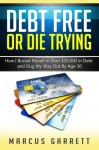
Debt Free or Die Trying is the sometimes serious, most-times amusing story of how I buried myself in over $30,000 in debt. This book will help you stop living the lifestyle of the fast and the financially frivolous and develop a sustainable plan based on proven tools that allowed me to become debt free. I believe you can become debt free, too. This book will show you: •How I buried myself in over $30,000 in debt before age 30 •How and why I reached “rock bottom” and decided to become debt free •The four Debt Free or Die Trying keys to success and the five payment strategies I used to pay off all of my debts For more information and other helpful tips, visit DebtFreeOrDieTrying.com.